Quick answer: a 4-string bass is tuned E A D G and a 5-string adds a low B below the E, tuned B E A D G. The extra string gives you deeper notes and more ways to play a line without moving up and down the neck. Your strings must match your bass: a 4-string needs a 4-string set, and a 5-string needs a 5-string set with a heavy low B.
| 4-string bass | 5-string bass | |
|---|---|---|
| Standard tuning (low to high) | E A D G | B E A D G |
| Lowest open note | E | B, five semitones below the E |
| Neck | Narrower, often easier for beginners | Wider, with more strings to keep quiet |
| Our matching set | .040–.100 or .045–.105 | .045–.125 |
What is the difference between a 4-string and a 5-string bass?
The 4-string is the classic electric bass. It has the same four notes as the lowest four strings of a guitar, one octave lower: E, A, D and G. Most of the bass lines you know from rock, pop, soul and funk were written for four strings, and most bass lessons and tab assume a 4-string.
A 5-string keeps those four strings and adds one more, almost always a low B below the E. That one extra string changes what the instrument can do. You get five more notes at the bottom of the range, and you can play many lines lower down the neck instead of shifting position. If you want a refresher on the string names, our guide to bass guitar string notes covers EADG and BEADG with easy ways to remember them.
Some 5-string basses are set up with a high C on top instead of a low B (E A D G C), but this is much less common. If you’re unsure how your bass is tuned, check the thickest string: a very thick string below the E means you have a low B.
What does the low B string add?
- Lower notes. The open B gives you B, C, C#, D and D# below the open E. These are useful for heavier styles, modern pop and worship music, and any song written in a low key.
- Drop tunings without retuning. Songs written for a bass tuned down to D can be played on a 5-string in standard tuning, because the D is right there on the B string.
- Fewer position shifts. You can often play a line across the strings in one area of the neck, rather than jumping up and down a single string.
- A different feel in the low end. Notes played on the B string at lower frets sit deep in the mix. Many players use the B string mostly for occasional low notes rather than whole songs.
Is a 5-string harder to play?
It takes some getting used to. The neck is wider, so your fretting hand has further to stretch across it, and the strings may sit a little closer together depending on the bass. You also have one more string to keep quiet: when you play on the higher strings, the low B can ring on by itself unless you mute it with your thumb or fretting hand.
None of this is a reason to avoid a 5-string, but it is why many teachers suggest learning on a 4-string first. If you already play a 4-string, most players find they adapt after a few weeks of regular practice.
4-string vs 5-string: which should you choose?
A 4-string suits you if you’re starting out, you mainly play rock, blues, punk, soul or older pop, you like a narrower neck, or you follow lessons and tab written for four strings.
A 5-string suits you if you play in bands that use low keys or down-tuned guitars, you play metal, modern worship or modern pop, you read parts that go below E, or you want more range without retuning.
If you’re still unsure, think about the music you play most. If you rarely need a note below E, a 4-string will do everything you need. If you keep reaching for notes that aren’t there, or detuning between songs, a 5-string will make life easier.
Which strings do you need for each bass?
Bass strings are sold in sets for a set number of strings, so the first thing to match is the count. A 4-string bass takes a 4-string set and a 5-string bass takes a 5-string set. A 5-string set includes a much heavier string for the low B, which is why it costs a little more.
For a 4-string, the main choice is gauge. A lighter set such as .040–.100 is easier on the fingers and suits fast playing. A standard set such as .045–.105 gives more tension and a fuller low end. Our guide to bass guitar string gauges explains these numbers in more detail.
For a 5-string, our .045–.125 set runs from a .045 G string down to a .125 low B. The heavy B string is what gives it enough tension to stay clear and in tune at such a low pitch.
The other thing to check is scale length. All three of our bass sets are long scale, with a 37.5-inch winding that suits most 34-inch basses. If you have a short-scale bass, or an extra-long-scale 5-string, check the length before you buy.
Can you put 5-string strings on a 4-string bass?
Some players do. They take the four lowest strings from a 5-string set and tune the bass B E A D, giving up the G string to get the low B. This is sometimes called BEAD tuning. It usually needs the nut slots widening for the thicker B string, and the setup may need adjusting, so it is a job for a guitar technician rather than a quick string change. If you want the low B and the G, a 5-string bass is the simpler answer.
Whichever bass you play, fitting the set is the same process. Our step-by-step guide on how to change bass strings covers both 4 and 5-string basses.
4-string vs 5-string bass: FAQs
Should a beginner start on a 4-string or a 5-string bass?
Most beginners start on a 4-string. The narrower neck is easier to get round, there is less muting to think about, and most lessons are written for four strings. You can move to a 5-string later, and everything you learn carries across.
Do 5-string bass strings cost more?
Usually, yes, because you get an extra string and the low B uses more metal. Our 4-string sets are £29 and our 5-string set is £35.
Can I use a 4-string set on a 5-string bass?
Not as a full set, because you would be one string short and missing the heavy low B. Always buy a set made for the number of strings on your bass.
Does a 5-string bass sound different on the same notes?
Played on the E, A, D and G strings, a 5-string can sound very much like a 4-string. The main difference is the extra low range of the B string. Things like the pickups, the wood and the strings you fit have just as much effect on the overall tone.
Strings for 4 and 5-string basses
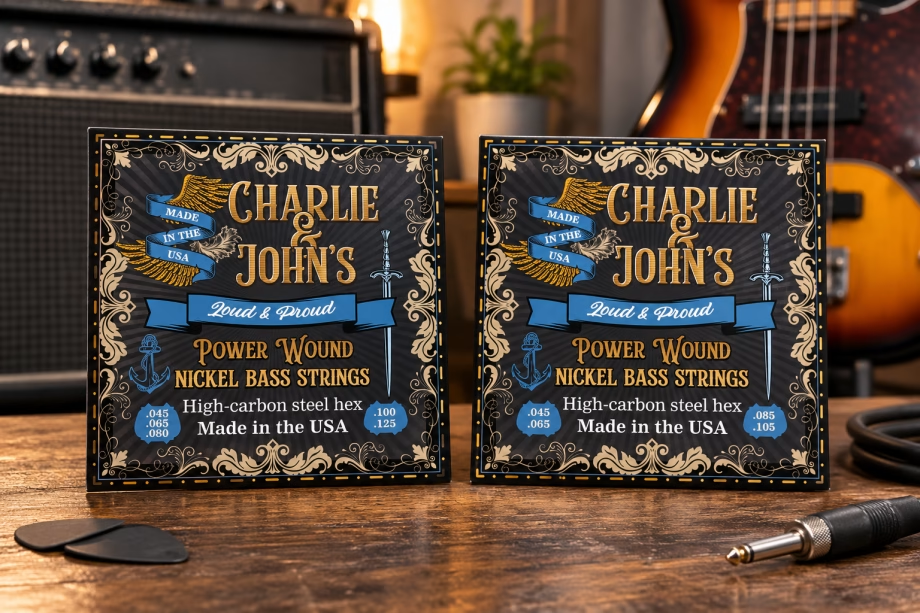
Our Power Wound nickel bass strings are handcrafted in the USA, with a high-carbon steel hex core and a nickel-plated steel wrap. They are long scale (37.5-inch winding) to suit most 34-inch basses, and we send them from Bedfordshire.
- .040–.100 4-string: lighter and easier to fret, £29
- .045–.105 4-string: the standard set, £29
- .045–.125 5-string: adds a low B, £35
Shop bass guitar strings. Not sure which set? Read our guide to the best bass guitar strings.